
[2026 Spring] Digital Logic Design
Course Information
| Course | Digital Logic Design | Department | Computer Science and Engineering |
|---|---|---|---|
| Office Hours | TBD | Course No. | 36500-02 |
| Hours | 3.0 | Academic Credit | 3.0 |
| Professor | Yoon, Myung Kuk | Office | Asan Engineering Building, 105-3 |
| Telephone | (82)-2-3277-3819 | myungkuk.yoon at ewha.ac.kr | |
| Value of Competence | Pursuit of Knowledge (80), Creative Convergence (20) | Keyword | Logic circuits, Combinational Logic, Sequential Logic |
| Class Time | (Wed) 17:00 ~ 18:15 (Fri) 17:00 ~ 18:15 | Class Room | ENGB151 |
| TA | Park, SeJin | TA E-Mail | park.sejin at ewha.ac.kr |
Course Description
Digital (or Boolean) Logic is a system of rules that allow us to make complicated decisions based on simple YES/NO (1/0) questions. Students will learn what digital logic is and how digital logic works in this class. The primary syllabus used for this course is from the website rather than the traditional school system. Consequently, any significant updates or changes will be made exclusively to the web syllabus.
Prerequisites
NONE
Course Format
| Lecture | Discussion/Presentation | Experiment/Practicum | Field Study | Other |
|---|---|---|---|---|
| 100% | 0% | 0% | 0% | 0% |
Course Objectives
In this class, students will be introduced to:
- An overview of integrated circuit technology
- Logic functions and circuits
- Boolean algebra for dealing with logic functions
- Logic gates
- Analysis of circuits
- How transistors operate
- Graphical representation of logic functions in the form of Karnaugh maps
- Representation of numbers in computers
- Circuits used to perform arithmetic operations
- Commonly used combinational sub-circuits
- Multiplexers, Flip-flops, Registers, Shift registers, and so on
- Sequential behavior of digital circuits
- Hardware description languages: VHDL and Verilog
- More if time permits
AI Use Principles and Guidelines
Use of Generative AI in Assignments
Students are ENCOURAGED to utilize Generative AI tools (e.g., ChatGPT, Claude, GitHub Copilot) to assist in their learning process and coursework. However, the following conditions apply:
- Verification of Accuracy: AI-generated content is not always correct. It is your responsibility to critically evaluate and verify the technical accuracy of any AI-provided output.
- Originality & Identical Submissions: While you may use AI as a resource, the final submission must be your own individual work. Please be advised that if multiple students submit identical or near-identical code—even if generated independently by an AI and not shared between peers—it will be treated as a violation of academic integrity.
- Consequences: Any instance of identical work will result in an automatic grade of F. The student bears full responsibility for the risks and consequences of using AI tools.
Strict Prohibition During Exams
The use of AI is strictly prohibited during all examinations:
- No Electronic Devices: All electronic devices are forbidden during exam sessions.
- Individual Assessment: Exams are intended to evaluate your personal understanding of the course material. Any attempt to access AI or external assistance during an exam will be handled according to the university’s strictest disciplinary policies.
Evaluation System
Relative + Absolute Evaluation
| Midterm Exam | Final Exam | Quizzes | Presentations | Projects | Assignment | Participation | Other |
|---|---|---|---|---|---|---|---|
| 35% | 35% | 0% | 0% | 0% | 30% | 0% | 0% |
*Evaluation of group projects may include peer evaluations. Explain of evaluation system
- About 35% of students: A
- About 45% of students: B
- About 20% of students: C and below
- If your total score is above 20% but does not exceed 30%, you will receive a “D” regardless of the percentage above.
- If your total score does not exceed 20%, you will receive an “F” regardless of the percentage above.
- You may be absent up to five times. If you exceed five absences, you will receive an “F” for the course. No excuses for absences will be accepted under any circumstances. Please note that the first two classes (the first week) will not be counted toward your absence total.
- If you are late twice, you are considered absent once.
- Complete your assignments and exams independently. Any instances of plagiarism, whether from fellow students or online sources, will result in an automatic 'F' in this course, regardless of your current standing.
Required Materials
You do NOT need to buy all the books below. You just need one of the books!
-
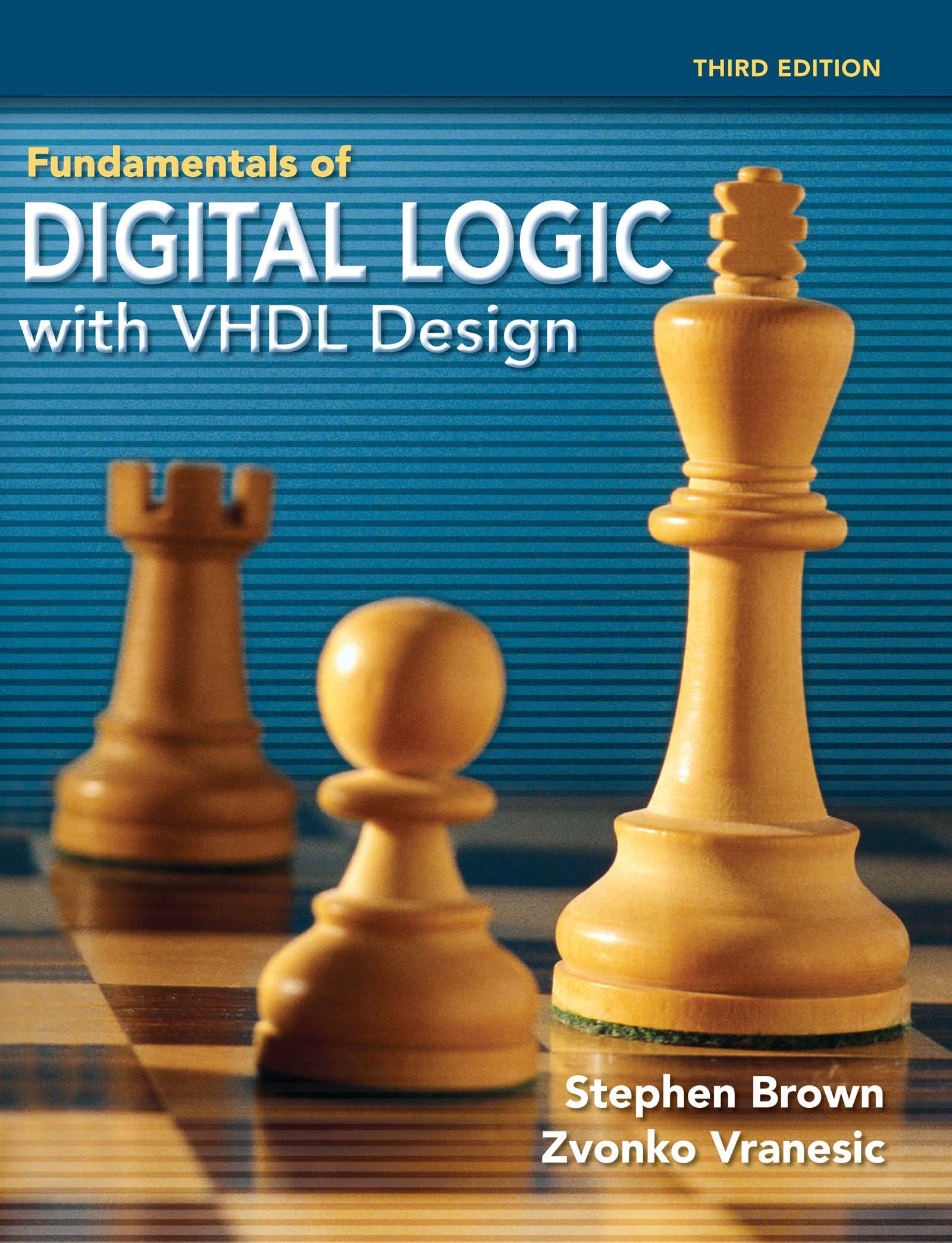
Fundamentals of Digital Logic with VHDL Design
Stephen Brown and Zvonko Vranesic Edition: Third (3E) ISBN-13: 978-0073529530 ISBN-10: 0073529532
-
Fundamentals of Digital Logic with VHDL Design
Stephen Brown and Zvonko Vranesic Edition: Third (3E) + International ISBN-13: 978-0071268806
-
Fundamentals of Digital Logic with Verilog Design
Stephen Brown and Zvonko Vranesic Edition: Third (3E) ISBN-13: 978-0073380544 ISBN-10: 0073380547
-
Fundamentals of Digital Logic with Verilog Design
Stephen Brown and Zvonko Vranesic Edition: Third (3E) + International ISBN-13: 978-1259072031
Supplementary Materials
NONE
Optional Additional Readings
NONE
Course Contents
| Week | Date | Topics & Materials | Etc. |
|---|---|---|---|
| Week #01 | 2026-03-04 (Wed) | CH #00: Digital Logic Design | |
| 2026-03-06 (Fri) | CH #01: Design Concepts | ||
| Week #02 | 2026-03-11 (Wed) | ||
| 2026-03-13 (Fri) | CH #02: Introduction to Logic Circuits | ||
| Week #03 | 2026-03-18 (Wed) | ||
| 2026-03-20 (Fri) | |||
| Week #04 | 22026-03-25 (Wed) | ||
| 2026-03-27 (Fri) | CH #03: Implementation Technology | ||
| Week #05 | 2026-04-01 (Wed) | ||
| 2026-04-03 (Fri) | CH #04: Optimized Implementation of Logic Functions | ||
| Week #06 | 2026-04-08 (Wed) | ||
| 2026-04-10 (Fri) | |||
| Week #07 | 2026-04-15 (Wed) | ||
| 2026-04-17 (Fri) | |||
| Week #08 | 2026-04-22 (Wed) | ||
| 2026-04-24 (Fri) | |||
| Week #09 | 2026-04-29 (Wed) | CH #05:Number Representation and Arithmetic Circuits | |
| 2026-05-01 (Fri) | NO CLASS | ||
| Week #10 | 2026-05-06 (Wed) | CH #05:Number Representation and Arithmetic Circuits | |
| 2026-05-08 (Fri) | |||
| 2026-05-09 (Sat) | MIDTERM EXAM | 09:00 ~ 10:15 | |
| Week #11 | 2026-05-13 (Wed) | CH #06: Combinational-Circuit Building Blocks | |
| 2026-05-15 (Fri) | |||
| Week #12 | 2026-05-20 (Wed) | ||
| 2026-05-22 (Fri) | CH #07:Flip-Flops, Registers, Counters, and a Simple Processor | ||
| Week #13 | 2026-05-27 (Wed) | ||
| 2026-05-29 (Fri) | NO CLASS | EWHA's 140th Anniversary Ceremony | |
| Week #14 | 2026-06-03 (Wed) | NO CLASS | Local Elections Day |
| 2026-06-05 (Fri) | CH #08:Synchronous Sequential Circuits | ||
| Week #15 | 2026-06-10 (Wed) | ||
| 2026-06-12 (Fri) | Semester Summary | ||
| 2026-06-13 (Sat) | FINAL EXAM | 09:00 ~ 10:15 | |
| Week #16 | 2026-06-17 (Thu) | Final Exam Review (Nonmandatory) | |
| 2026-06-19 (Fri) | NO CLASS |
Course Policies
*For laboratory courses, all students are required to complete lab safety training.
Special Accommodations
*According to the University regulation #57, students with disabilities can request special accommodation related to attendance, lectures, assignments, and/or tests by contacting the course professor at the beginning of semester. Based on the nature of the students’ requests, students can receive support for such accommodations from the course professor and/or from the Support Center for Students with Disabilities (SCSD).
Extra Information
The contents of this syllabus are not final—they may be updated.