
[2026-Spring] Software for Artificial Intelligence
Course Information
| Course | Software for Artificial Intelligence | Department | Artificial Intelligence and Software |
|---|---|---|---|
| Office Hours | TBD | Course No. and Class | G18458 - 01 |
| Hours | 3.0 | Academic Credit | 3.0 |
| Professor | Yoon, Myung Kuk | Office | Asan Engineering Building, 105-3 |
| Telephone | (82)-2-3277-3819 | myungkuk.yoon at ewha.ac.kr | |
| Value of Competence | - | Keyword | - |
| Class Time | (Tue.) 12:30 ~ 15:15 | Class Room | ENGA124 |
Course Description
The unprecedented advancement of Artificial Intelligence (AI) in recent years is deeply rooted in the evolution of parallel programming. As hardware performance growth slows, the ability to harness massive computational power through parallelization has become the definitive factor in AI scalability, with GPU acceleration via CUDA serving as the backbone for modern deep learning breakthroughs. This course provides a comprehensive exploration of parallel computing architectures and programming models, allowing students to move beyond sequential logic to explore industry-standard paradigms such as shared memory programming with Pthreads and OpenMP, distributed memory programming using MPI, hardware acceleration with NVIDIA CUDA, and data-level parallelism through AVX-512 SIMD instructions. Through this course, students will gain practical experience with these essential tools and develop a fundamental understanding of how to enhance software performance for modern AI applications.
Prerequisites
Computer Architecture
Course Format
| Lecture | Discussion/Presentation | Experiment/Practicum | Field Study | Other |
|---|---|---|---|---|
| 70% | 30% | 0% | 0% | 0% |
Course Objectives
In this class, students will be introduced to:
- Shared Memory Programming: Utilizing Pthreads and OpenMP for multi-core CPU optimization.
- Distributed Memory Programming: Leveraging MPI (Message Passing Interface) for large-scale cluster computing.
- Hardware Acceleration: Implementing high-performance kernels with NVIDIA CUDA for GPUs.
- Data-Level Parallelism: Exploiting AVX-512 SIMD instructions to maximize CPU throughput.
AI Use Principles and Guidelines
Use of Generative AI in Assignments
Students are ENCOURAGED to utilize Generative AI tools (e.g., ChatGPT, Claude, GitHub Copilot) to assist in their learning process and coursework. However, the following conditions apply:
- Verification of Accuracy: AI-generated content is not always correct. It is your responsibility to critically evaluate and verify the technical accuracy of any AI-provided output.
- Originality & Identical Submissions: While you may use AI as a resource, the final submission must be your own individual work. Please be advised that if multiple students submit identical or near-identical code—even if generated independently by an AI and not shared between peers—it will be treated as a violation of academic integrity.
- Consequences: Any instance of identical work will result in an automatic grade of F. The student bears full responsibility for the risks and consequences of using AI tools.
Strict Prohibition During Exams
The use of AI is strictly prohibited during all examinations:
- No Electronic Devices: All electronic devices are forbidden during exam sessions.
- Individual Assessment: Exams are intended to evaluate your personal understanding of the course material. Any attempt to access AI or external assistance during an exam will be handled according to the university’s strictest disciplinary policies.
Evaluation System
Relative + Absolute Evaluation
| Midterm Exam | Final Exam | Quizzes | Presentations | Projects | Assignment | Participation | Other |
|---|---|---|---|---|---|---|---|
| 0% | 40% | 0% | 20% | 20% | 20% | 0% | 0% |
*Evaluation of group projects may include peer evaluations. Explain of evaluation system:
- About 80% of students: A
- About 20% of students: B and below
- If you are absent more than three times, you will get an "F."
- If you are late twice, you are considered absent once.
- Complete your assignments and exams independently. Any instances of plagiarism, whether from fellow students or online sources, will result in an automatic 'F' in this course, regardless of your current standing.
Required Materials
The lecture notes will be posted on the course website.
* Lecture materials will be provided in English.Supplementary Materials
-
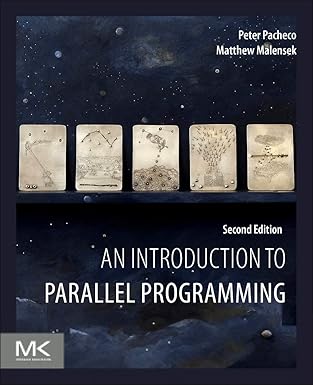
An Introduction to Parallel Programming
Peter Pacheco and Matthew Malensek Edition: Second (2nd) ISBN-13: 978-0128046050 ISBN-10: 0128046058
Optional Additional Readings
NONE
Course Contents
| Week | Date | Topics & Materials | Assignement & Quiz |
|---|---|---|---|
| Week #01 | 2026-03-03 (Tue) | Lecture #01: Class introduction | |
| Week #02 | 2026-03-10 (Tue) | Lecture #02: [CH#01] Why Parallel Computing | |
| Week #03 | 2026-03-17 (Tue) | Lecture #03: [CH#02] Parallel Hardware and Parallel Software | |
| Week #04 | 2026-03-24 (Tue) | Lecture #04: [CH#02] Parallel Hardware and Parallel Software | |
| Week #05 | 2026-03-31 (Tue) | Lecture #05: [CH#03] Distributed Memory Programming with MPI | |
| Week #06 | 2026-04-07 (Tue) | Lecture #06: [CH#03] Distributed Memory Programming with MPI | |
| Week #07 | 2026-04-14 (Tue) | Lecture #07: [CH#04] Shared-Memory Programming with Pthreads | |
| Week #08 | 2026-04-21 (Tue) | Lecture #08: [CH#04] Shared-Memory Programming with Pthreads | |
| Week #09 | 2026-04-28 (Tue) | Lecture #09: [CH#04] Shared-Memory Programming with OpenMP | |
| Week #10 | 2026-05-05 (Tue) | NO CLASS | Children's Day |
| Week #11 | 2026-05-12 (Tue) | Lecture #10: [CH#04] Shared-Memory Programming with OpenMP | |
| Week #12 | 2026-05-19 (Tue) | Lecture #11: [CH#05] GPU Programming with CUDA | |
| Week #13 | 2026-05-26 (Tue) | Lecture #12: [CH#05] GPU Programming with CUDA | |
| 2026-05-30 (Sat) | Lecture #13: Final Exam | ||
| Week #14 | 2026-06-02 (Tue) | Lecture #14~15: Final Project Presentation | |
| Week #15 | 2026-06-09 (Tue) | ||
| Week #16 | 2026-06-16 (Tue) | NO CLASS |
Course Policies
*For laboratory courses, all students are required to complete lab safety training.
Special Accommodations
*According to the University regulation #57, students with disabilities can request special accommodation related to attendance, lectures, assignments, and/or tests by contacting the course professor at the beginning of semester. Based on the nature of the students’ requests, students can receive support for such accommodations from the course professor and/or from the Support Center for Students with Disabilities (SCSD).
Extra Information
The contents of this syllabus are not final—they may be updated.